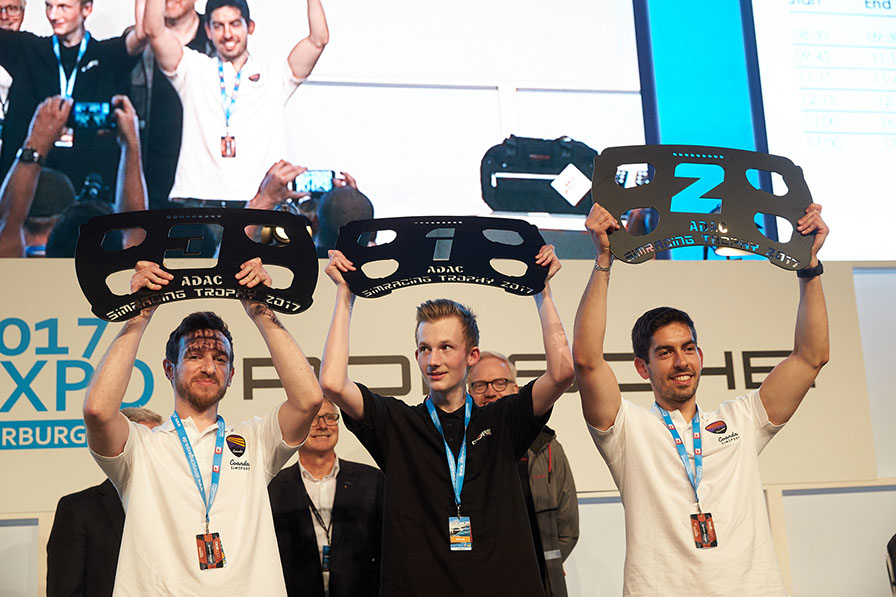
Last month, the world of simracing gathered at the SimRacing Expo at the Nürburgring, with some of the top of them competing in the 2017 ADAC SimRacing Trophy. With ten rigs from the organisation, forty gamers battled it out locally, with an audience at the venue, as well as viewers online. VRS coaches Jeremy Bouteloup and David Williams came second and third in the final, with Frederik Rasmussen of CoRe SimRacing taking the victory. We catch up with all three of them here.
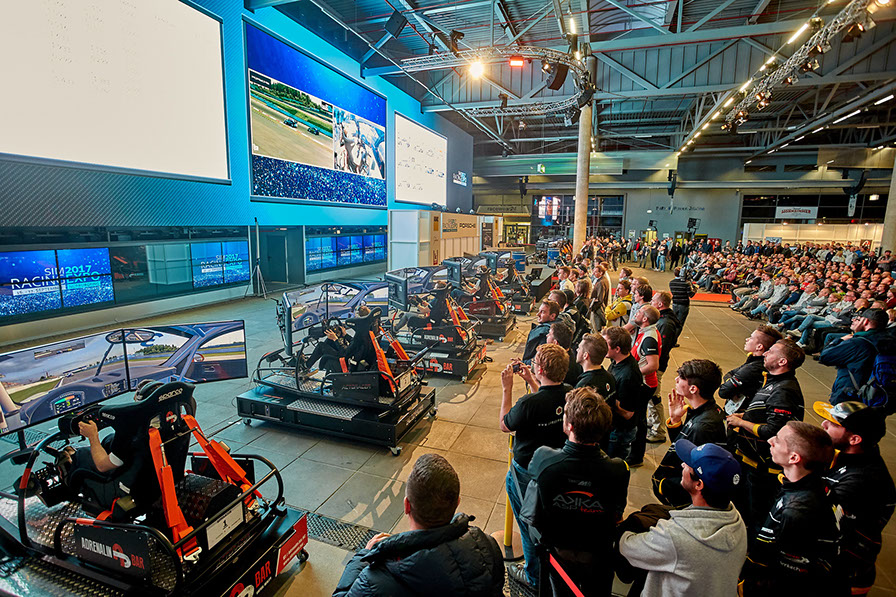
Do you feel a different kind of tension when you’re racing in front of an audience and not in your own home?
David: “You certainly feel the atmosphere, which is very audible while driving, even though we have headphones on. There were moments during the final when Jeremy was fending off Frederik where I could barely hear the car, such was the noise level of the crowd and the live commentary through the speakers above the stage. In addition you have cameras moving in and out of the rigs, sometimes in your face, which can be very distracting! I have to say though, the excitement is something you don’t get at home, which you can feed off to fuel your focus.”
Jeremy: “It’s definitely different. While at home it’s only you and your rig, on stage it really feels like you’re in an arena. You generally hear the crowd, the commentators, and that can be quite distracting if you’re not used to it. You really need to focus on what you’re doing because when you start thinking about who’s watching you, or see the cameraman trying to get good shots of you, then that really can lead to on track mistakes. But it’s a great experience if you’re performing well, because everything you feel is amplified as you can share it with the crowd!”
Frederik: “It was definitely different to race with everyone watching, but after a few laps I forgot about it and was able to focus on the driving only. Yet when a camera man comes over and films you it can be very distracting, making it hard to concentrate.”
Do you miss your own rig and the software you have installed at home? Or you just quickly learn cope with it?
Frederik: “I didn’t miss my rig, because it was the same for everyone. But I must say it was quite hard to have only a short time to get used to a brake pedal that’s twenty times harder than what I have at home, and the seat was moving a bit!”
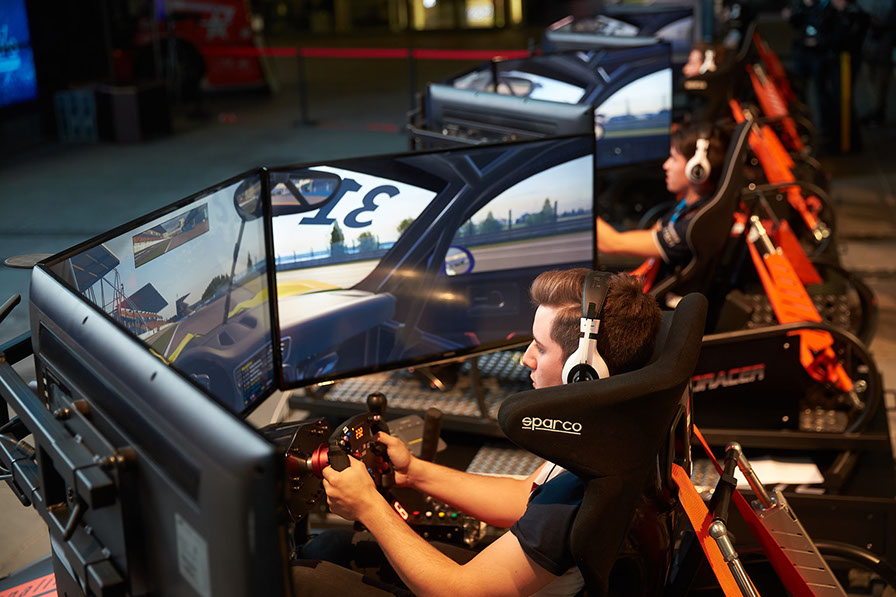
David: “The software is exactly the same as at home, but the settings (no changes allowed) and hardware are very different. Fortunately I’ve got decent experience with unfamiliar rigs and so adapting wasn’t too much of an issue, however it’s always difficult and seemingly minor differences can throw people off what they’re comfortable with and what they have muscle memory with. This year, each rig had slightly different wheel and pedals, which made things even trickier, because after each heat you’re in a different one. Yet the format was great and forced everyone to adapt.”
Jeremy: “It depends on the rig that you have at the event. It’ll never be the same so you always need to adapt, but with experience you’re able to adapt quickly and perform decently with equipment you’re not familiar with. Depending on the event, that’s sometimes the key to a good performance because you have limited seat time to get accustomed to the rig you have to use.”
— © SimRacing Expo
How does it work with setups? Do you quickly make the changes you memorised?
Jeremy: “In these events you generally have limited setup options available, as the difference is only supposed to be made on driving. For this competition, only the brake bias was available but that was a key one since the Porsche doesn’t have ABS. So setting this, I went on the safe side because I didn’t feel as confident with the equipment as at home.”
David: “As Jeremy said, the SimRacing Trophy event only allowed adjustments to the brake bias. If the setup was open, I’d probably bring a photo of the garage screen or a USB stick to copy settings across.”
You have your headphones on, but do you hear anything from the audience behind you or the commentators? Do you ever look to your left or right to see what other competitors are doing?
Jeremy: “Despite having headphones, you definitely hear what’s going on around you! You can hear the crowd applauding when there’s a nice overtake, the commentators shouting a drivers name, and so on. You can have a sideways look at other competitors, but there’s not really a point in doing so as you need to focus on your own race. Obviously, this is much harder to do in this type of environment because you have a lot more distractions than at home.”
David: “As Jeremy said, the noise levels are so loud at the event that it’s still difficult to hear the sim clearly at times, and cues such as tyre noise which we rely on at home can become very difficult to sense. Technically you can see the rigs immediately to the sides of you, but the best strategy really is to try and block out external distractions as much as you can.”
Frederik: “I could hear audience and commentators well, but I don’t really ‘listen’ to it. And yeah I tried to look to the persons next to me sometimes, but you couldn’t really see very clearly, heh.”
How’s the whole event? Does simracing need more local events?
Frederik: “The whole event was just epic, I wish there would be a lot more of these events to meet people and race with them.”
Jeremy: “The whole event is definitely a nice showcase for simracing. It’s great for the drivers, for the teams involved, and for the public. It’s a unique experience to see online racing being on-site and it makes it much more engaging for everyone. From a drivers’ perspective, it can be really stressful but also enjoyable to perform in front of a crowd. There aren’t so many events like this one and simracing being a rather small e-sport, it definitely helps bring more attention around it. It’s also a great opportunity to meet people you are racing with or against all year long and put faces to name.”
David: “I really love live events like this year’s SimExpo. It’s an awesome chance to put faces to the names you find yourself racing against online, not to mention friends and teammates you’ve gotten to know so well, and whom you get the chance to share drinks with in the evening (and early morning!). The atmosphere and passion you feel in person watching the races in my opinion surpasses even real racing, given how accessible the drivers are to spectators, and I really see this as being the best chance for simracing as an e-sport to grow. I’d love to see major online championships conclude with similar in-person live finals, as it warrants the kind of buzz and excitement such high level competition deserves.”
The 2018 SimRacing Expo is again held at the Nürburgring boulevard, at 15 and 16 September 2018.
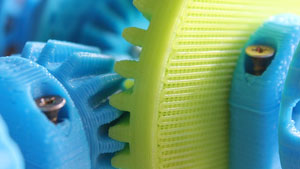 The differential (or diff, for short) allows the left and right wheels to rotate independently, which helps balance the car through corners. Its configuration determines how much of the torque coming off the engine is transferred to each wheel. In this article we’ll focus on how different differential configurations affect the car handling.
 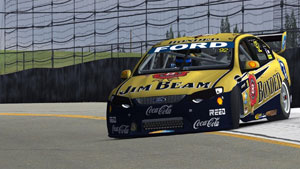 A spool gives you good traction accelerating on a straight line, but the handling of the car is compromised during turning. When going around a corner, the outside tire has to travel a longer distance. So, the inside is forced to rotate faster than it needs for the turn radius and hence spins. This causes stress (wear) on both tires and the drive train. In terms of handling, this causes understeer when decelerating, and oversteer when accelerating.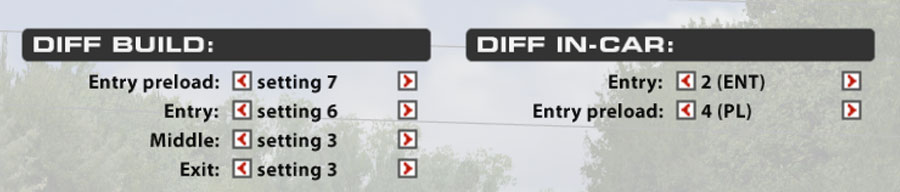
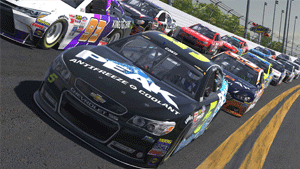 Your first week of oval racing is just about the same as when you try anything for the first time, so take it easy! One of the biggest mistakes that rookies make is trying to go too fast, too early. At first glimpse, an oval looks very simple. It’s got a couple straights and a couple long turns. This makes new drivers want to exit pit road and set a world record time on the first lap. However, you’ll soon realize that because the turns only go in one direction, and because the turns are generally longer than those on road courses, that the cars will be set up to only go left, that the car’s setup will be on the ragged edge of spinning out, in order to achieve competitive lap times.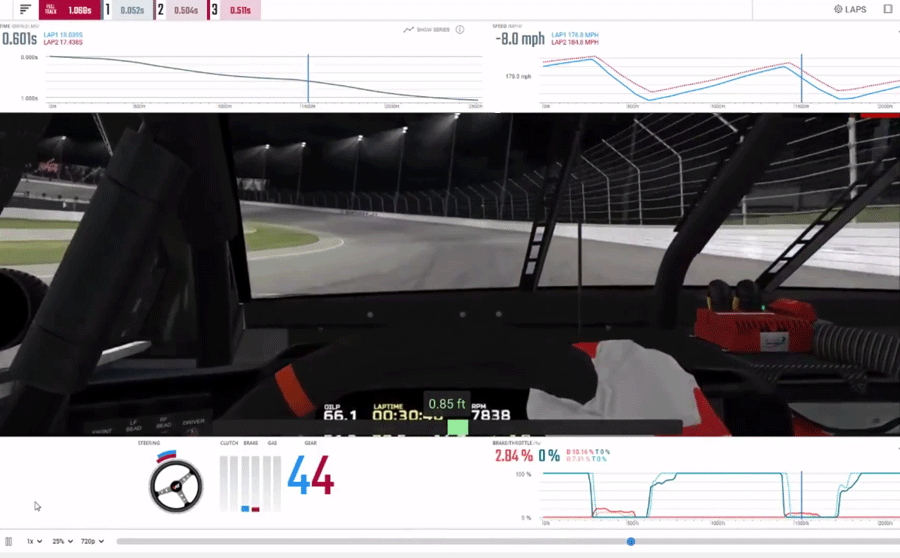

 A Californian iRacer currently living in Europe:
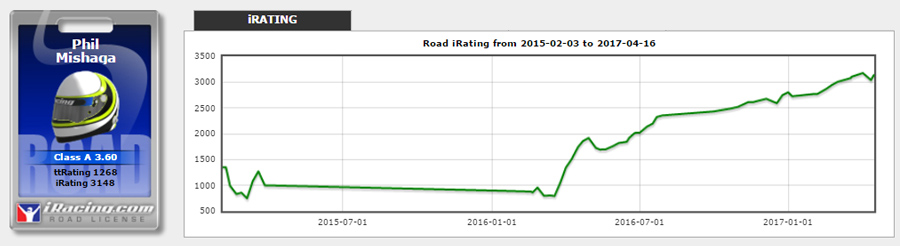
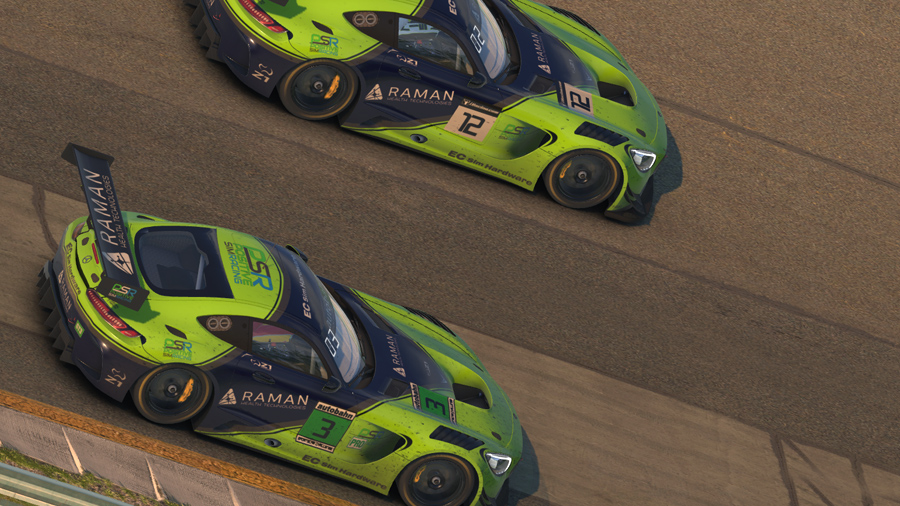
 In March 2017, the Positive Simracing Driver Development Programme, powered by Virtual Racing School, kicked off with eight talented drivers. One of the them is Ecuador-born and USA-bound
 The stereotype of oval racing is that racers just turn left, full throttle, and that therefore oval racing is easy. But there’s lots of skill involved in oval racing, especially with around forty cars with 725 horsepower fighting for the same piece of tarmac.